About
Spirit of Place
Numen — spirit of place. An art-science project inspired by the Big History approach to understanding our past and future.
Numen is an immersive multimedia song cycle exploring the origins, climate and landscapes of the Great Southern region and Albany in Western Australia — created by Albany-based media artist Peter Morse, with an original musical score by Western Australian composers Glenn Rogers and Steve Richter.
Using computer visualisation of climate, geophysical and astrophysical simulations, satellite data and 360-degree video, the visuals span billions of years — from cosmic beginnings through the separation from East Antarctica and the drift of the Australian continent, the drowning of King George Sound and the growth of the town, extending into inferred futures.
The song cycle situates Menang-Noongar language within the work, referencing the six Menang-Noongar seasons — Birak, Bunuru, Djeran, Makuru, Djilba, and Kambarang — two ways of reading the same country, each with something to learn from the other.
In the Room
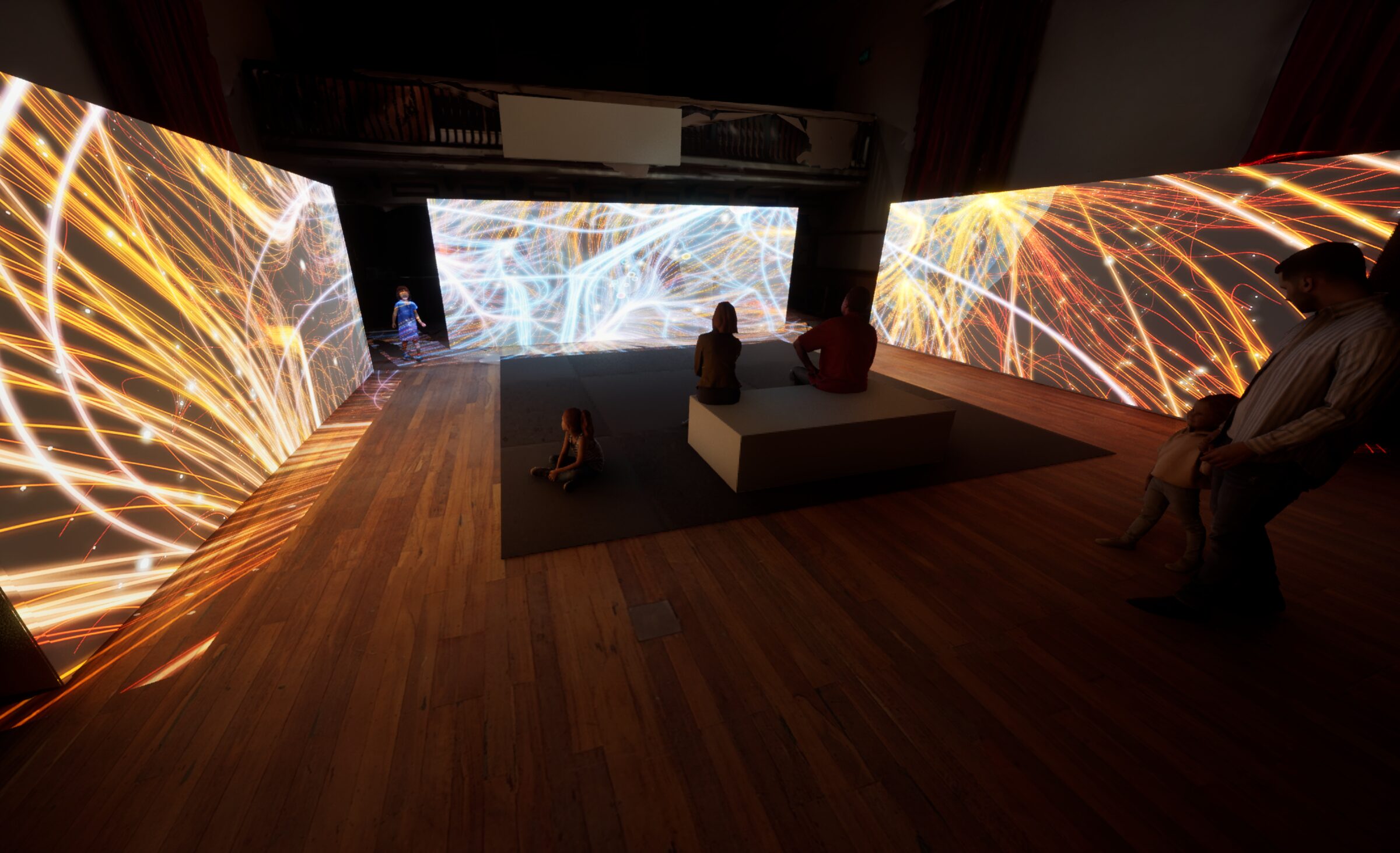
Three screens surround you, square to one another but standing apart — like windows onto the world. Numen is not a film but a place: a CAVE-like room you are inside, rather than a screen you sit in front of.
Often the three screens are windows onto one continuous world; at other times they hold different views, and the room becomes a triptych. There is no fixed seat and no correct place to stand. You can walk, sit or lie down, and what you see depends on where you turn and how long you stay.
Much of Numen moves slowly. Long horizons, weather crossing country, light shifting on granite — nearer to standing in front of a landscape painting than to watching a film. Nothing insists on being caught; the slow passages are there to be dwelt in.
Format
30 minutes · Six audiovisual compositions · Three screens · Albany Town Hall · 17 September – 14 October 2026, three screenings daily · Part of the Albany/Kinjarling 2026 program
Creators
Peter Morse — Director & Artist
Award-winning Australian media artist and computer researcher. His fulldome cinema works have screened in over 35 countries, including Dark (2012), Hemispheres of the Mind (2019), Travelling Kungkarankalpa (2017), and Frozen in Time (2008) — the first fulldome film shot in Antarctica. Peter holds PhDs in Cultural Heritage (Murdoch) and Computational Geophysics (Tasmania), and has held visualisation research positions at the Universities of Melbourne, UWA, Tasmania, and UNSW.
petermorse.net
Glenn Rogers — Composer & Musician
Perth-based composer and guitarist with international performance and recording experience. A classical composer first, his scores for planetarium domes and multimedia works are rooted in contemporary Western classical music, with influences from Indian classical traditions, European jazz and electronic music.
glennrogers.net
Steve Richter — Musician & Sound Designer
Over 25 years in the Western Australian music scene, with performance credits including the WA Symphony Orchestra. Steve specialises in electronic music and didgeridoo, bridging traditional Aboriginal instruments with contemporary soundscapes.
steverichtermusic.bandcamp.com
Peter Hardy — Narration
Australian actor, theatre performer and musician (1957–2023), known for McLeod's Daughters, Chopper and Blue Heelers — and the director's close friend and creative partner across several decades. Peter Hardy died in 2023. The narration in Numen is his voice, recreated with AI from recordings and used with the permission of his family. It is offered in his memory.
Peter Hardy — Wikipedia
Larry Blight — Readings, Six Seasons
Passionate about his Boodja (land) and all things on it, with deep knowledge of local bushfoods, medicines, stories and traditions, which he shares through workshops and school programs. In Six Seasons he reads the observations of place in the Menang language.
Rachael Colmer — Readings, Six Seasons
An accomplished actor, director and teacher. She teaches and mentors Indigenous students in local arts programs, as well as working as a freelance artist. In Six Seasons she reads the observations of place in the Menang language.
In memory
Numen is made in loving memory of my mother, Margaret Morse, who intended to be here to see it; my sister, Dr Kate Morse, archaeologist of the Pleistocene coasts of Western Australia, whose work runs through Six Seasons; my father, Gareth Morse, landscape painter, who taught me how to see a landscape; and my friend Peter Hardy, whose voice it carries.
— Peter Morse
How it was made
Numen was made by Peter Morse over eighteen months, with the final production in six intense months of 2026 — at home in Albany, on three computers: a Mac mini and two Windows workstations, the two PCs rendering through the night as a small render farm.
Most of the imagery is rendered in Blender and Unreal Engine 5. Blender carries Laniakea’s velocity-field streamlines, Earth’s palaeo-globe, the Four Seasons model town and the Futures globes; Unreal Engine carries the Six Seasons landscape with its seasonal forests, the Futures town and the Now point cloud. The Milky Way flights were made in SpaceEngine, images were prepared in Affinity Photo, and the work was assembled in DaVinci Resolve.
The science was prepared in Python, QGIS and the usual Linux command-line tools: plate reconstructions with GPlates, palaeoclimate model output, satellite imagery, elevation and seabed grids, sea-level curves. Heritage records, building footprints, land parcels and dated events were gathered into databases that drive the simulations. The Now scan was reconstructed from 360-degree video with COLMAP and Gaussian splatting.
AI was used throughout, as a tool rather than an author. Claude (Anthropic) was a programming and research partner across the project, writing and checking the code that processes the data and keeping the working journals that record what was done and why. Generative models made images and moving images: Google’s Gemini (Nano Banana) and OpenAI’s models for stills — among them the illustrated events of Earth and the source images for the generic houses of Four Seasons — and MiniMax H3 for short video clips, with local image and video workflows run in ComfyUI and a variety of open models from Hugging Face. Local language models such as Qwen, running in LM Studio and Unsloth Studio, worked alongside Claude. Peter Hardy’s voice was recreated from recordings with audio language models, with his family’s permission. Much of the AI work was experiment rather than output: Peter ran long series of measured tests to see how far vision-language models and MiniMax H3 could be directed — whether they would hold a coastline, keep a colour, respect a composition across three walls — and from the results built his own workflows for visual control. Every generated element is identified as such on the composition pages.
The 2026 season
Numen ran at Albany Town Hall from 17 September to 14 October 2026, as part of Albany/Kinjarling 2026 — the first immersive CAVE installation ever staged in the hall. It was officially opened on 18 September by Cr Lynn MacLaren on behalf of Mayor Greg Stocks, and played three times a day for four weeks, with booked-out sessions and artist talks for UWA Children’s University and the Great Southern, Great History community history day.
The season has closed; the soundtrack carries on. The composition pages describe the data, simulations and archives behind each part of the work.