What you see
Laniakea — Hawaiian for “immeasurable heaven” — is the name given in 2014 to the supercluster our galaxy belongs to (Tully et al., 2014): a region some 520 million light-years across, holding around a hundred thousand galaxies. The composition falls inward through it, scale by scale, from the flow of galaxies to the ignition of the Sun.
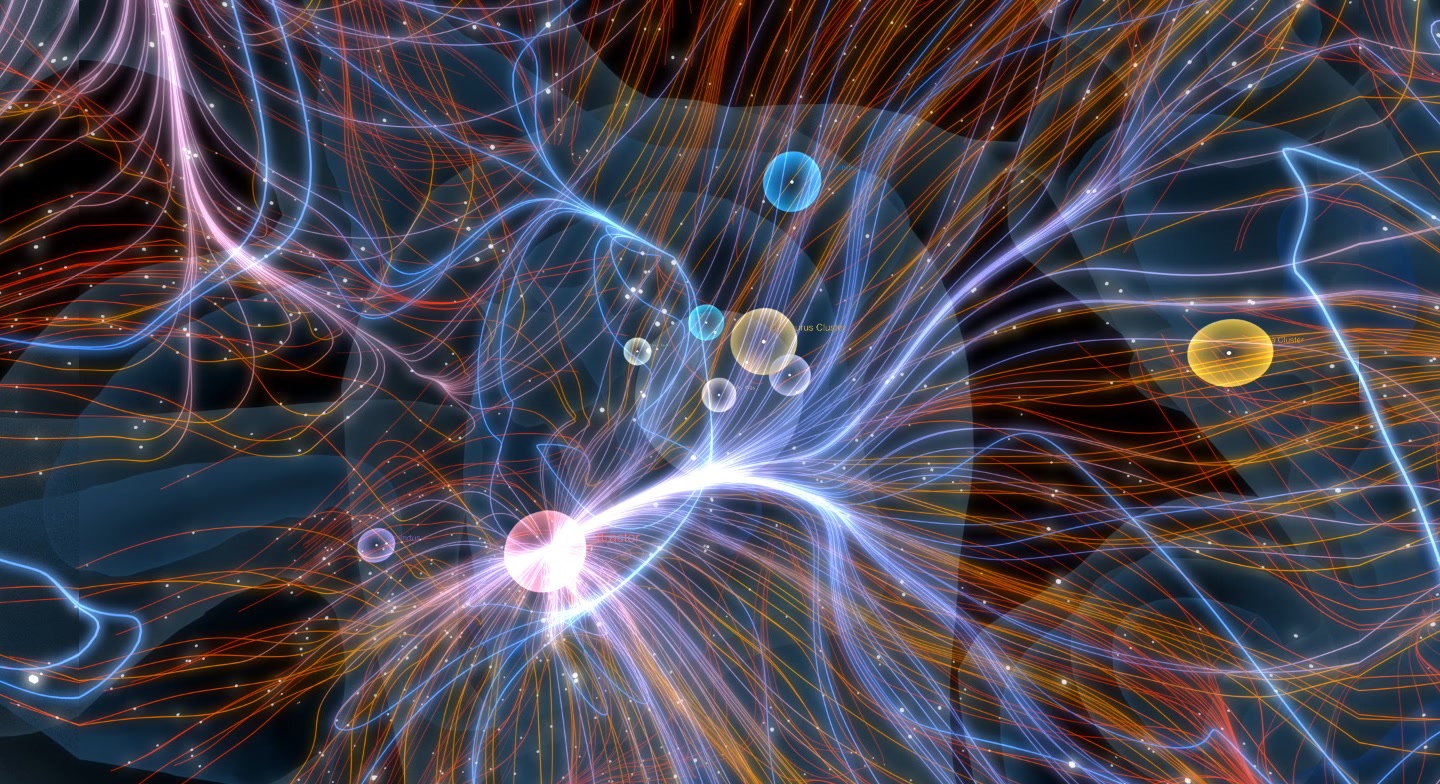
It opens on a map — not of where galaxies are, but of how they move. CosmicFlows-4 gathers distances to 55,877 galaxies (Tully et al., 2023); subtract the expansion of the universe and what remains is each galaxy’s own motion, the fingerprint of gravity. Five thousand streamlines are traced through that field of motion, the brightest where the flow is fastest, and the spheres mark the great structures along it. The map is a reconstruction, not a photograph, and it carries a surprise: we may belong to something larger than Laniakea itself (Valade et al., 2024).
Closer in, the observations run out of resolution and the composition passes from observation to model. IllustrisTNG is a universe evolved in a computer from the conditions of the early cosmos (Nelson et al., 2019a). In its TNG50 volume (Nelson et al., 2019b), gas falls along the unseen filaments of dark matter that shape the cosmic web, and galaxies kindle where they meet. It is not our neighbourhood — but it is what a neighbourhood like ours looks like.
Then the Milky Way, seen from outside. Its form follows the most recent model of our galaxy, derived from the European Space Agency’s Gaia mission, which has measured almost two billion of its stars one by one: more than two spiral arms, less prominent than once thought, and a central bar more inclined with respect to the Sun (ESA/Gaia/DPAC, 2025).
And then into it — a flight through the disc, among stars built from catalogues near the Sun and modelled beyond them.
At its centre, Sagittarius A* — a black hole of about four million times the mass of the Sun, bending the light of the stars around it.
From there we are flung toward our birthplace: a star-forming nebula, gas and dust gathering toward new stars, modelled in Blender for Numen.
Then a disc of gas and dust turning around a new star — the kind of place the Sun was born in, almost five billion years ago. Here the images are supercomputer simulations: a turbulent molecular cloud collapsing into young stars and their discs, and sixteen thousand years in the life of a young protoplanetary disc, testing whether giant planets can form directly as a disc fragments under its own gravity (Boley, Kritsuk & Norman; NASA SVS, 2021).
And the Sun ignites. Here the images are the real thing: the Sun in extreme ultraviolet, observed by NASA’s Solar Dynamics Observatory (Lemen et al., 2012). It carries us into Earth.