The music of Numen is a hybrid song cycle in six parts, one for each composition, in which spoken and sung voices, orchestra and electronics meet. It was written by Glenn Rogers and Steve Richter, with musical direction and lyrics by Peter Morse. It was written for a room rather than a screen: at Albany Town Hall the images surround the audience on three giant walls, and the music fills the hall around them. The Numen Soundtrack was released on 5 October 2026, with a bonus track, Laniakea Sun, available with the full album.
Peter Morse first brought in Glenn Rogers, with whom he has a long and successful history of working together. As the scope of the project grew, Glenn suggested bringing in Steve Richter as well, for his particular skills as a composer and his ability to record and mix.
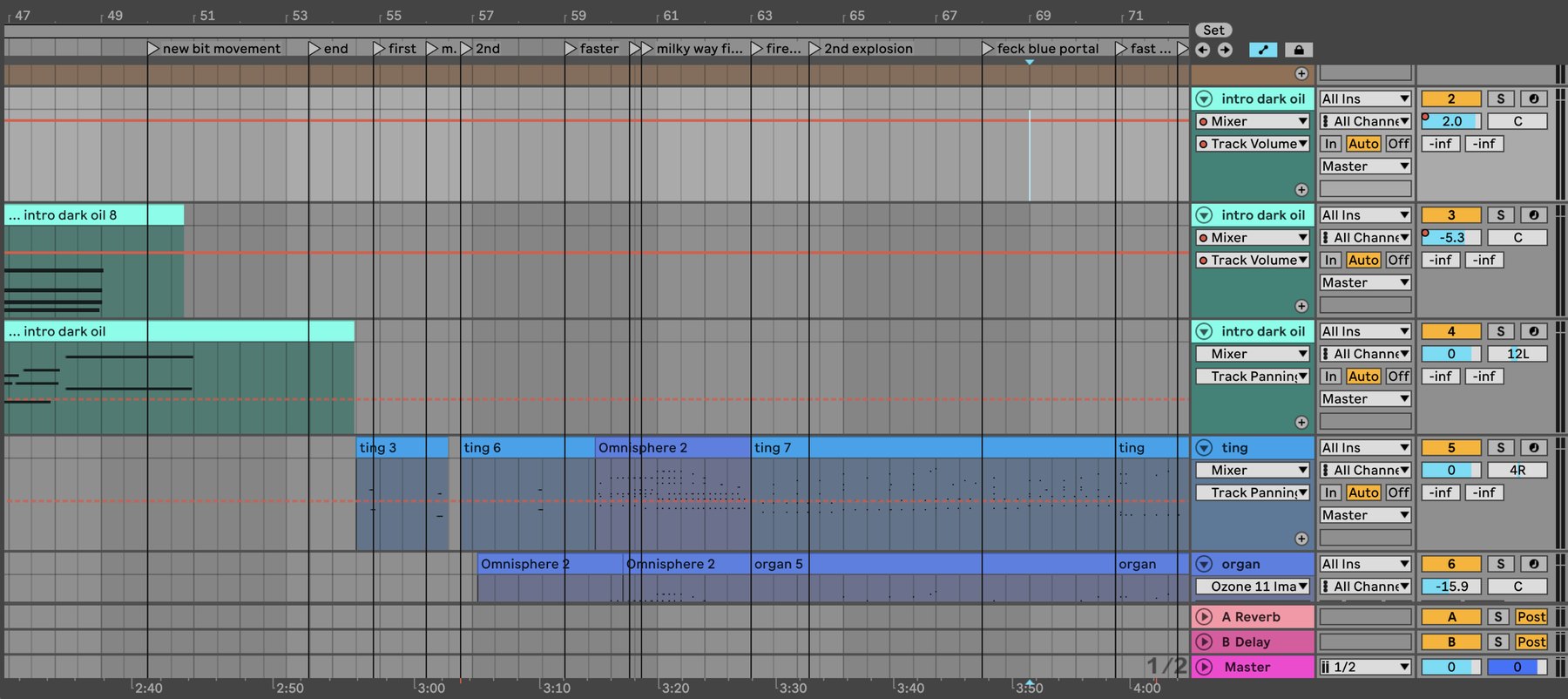
The music was written to the picture. Steve brought the visuals for each composition into his studio, watched them through again and again, and marked along the timeline the moments he wanted the music to meet. In his session for Laniakea, below, the markers run across the top: “new bit movement”, “2nd explosion”. Then he searched for sounds and played them against the unfolding images, take after take, shaping them until the music and the images belonged together: “It’s a feeling and sensitivity thing when watching and listening.” Glenn wrote Four Seasons and Futures on his own, and built up others in layers; the two studios passed tracks between them, seventy-five layers in Six Seasons alone.
Steve Richter’s Ableton session for Laniakea, from about 2:40 to 4:00, with moments in the picture marked along the top
The compositions
I · Laniakea 4:55
Steve Richter, with Glenn Rogers
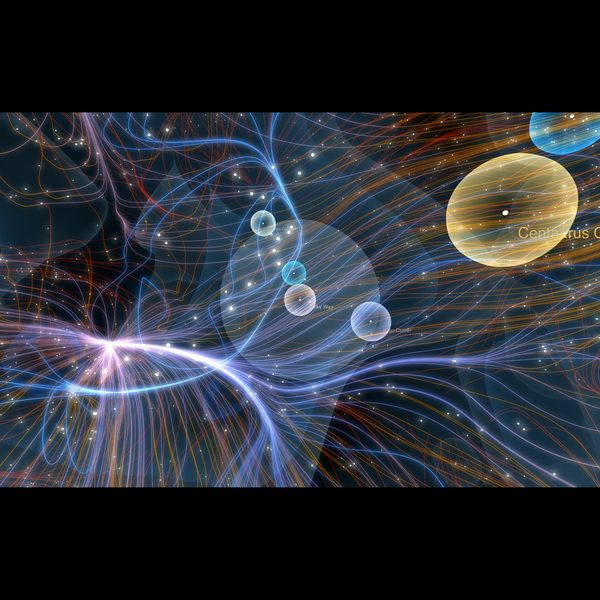
A struck gamelan marks the beginning. Laniakea was the first piece of the project, the one in which a way of working had to be found. Nineteen tracks of vast, evolving textures make up most of it, drawn from a range of digital synthesisers, above all seven layers of Omnisphere. There was no preconceived structure, only, in Steve’s words, “an organic growth” in response to the picture. Then came the questions — “Does this piece need more textures?” “What happens if I add this sound?” — and the process began again with the next sound.
Steve sent the piece to Glenn believing it was basically finished. Glenn added another eleven tracks and pads, some obvious and “in your face”, some subtle and in the background: delicate strings, and a great deal of low end. As he put it: “Peter likes a lot of bass!”
II · Earth 3:05
Steve Richter
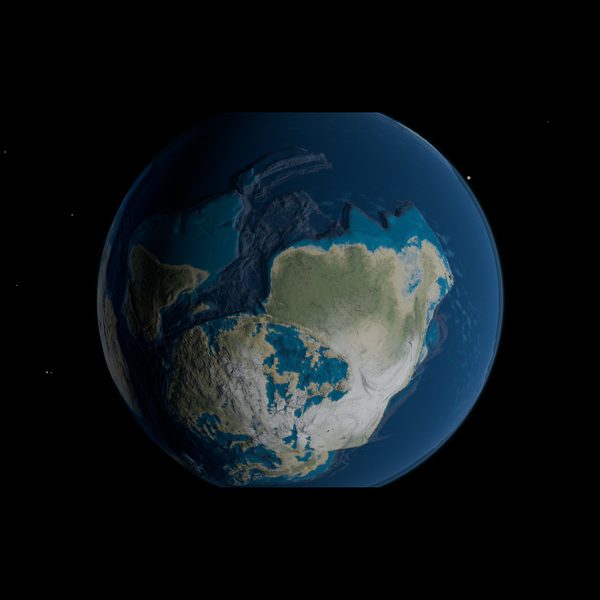
Voices were a must, as a nod to the song cycle: seven tracks of a contemporary choir, from Realitone’s finely detailed choir library, each timed to moments marked in the picture. The narration of Peter Hardy is treated the same way. Each narration track has its own EQ, its own reverb and its own place across the stereo field, so that each has its own character — its own voice.
III · Six Seasons 9:08
Steve Richter and Glenn Rogers
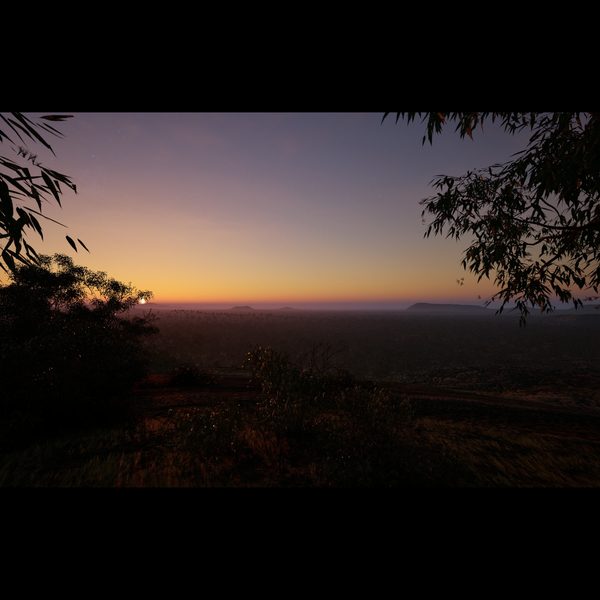
A true duet between the composers, in seventy-five layers of audio. Steve wrote the longer seasons. Birak opens with sound effects — a creaking forest, crickets — and the Menang voices, and its music comes mostly from whirlies: corrugated plastic tubes spun in circles through the air, so that the rushing air sounds notes of the harmonic series, rising as they spin faster. They were perfected in the 1980s by the Australian musician Sarah Hopkins, in her search for otherworldly, magical and spiritual sounds. Makuru is driven by percussion blending with the storm and the voices; towards the end the bass takes over, with a French horn to the fore. Steve played the horn on a breath and bite controller, which shapes the expression and vibrato of each note with the breath and the tilt of the head, using a sample library by Acoustic Samples.
Glenn wrote the others. Bunuru is the opposite of process music: sustained sound, slowly unfolding, for the awe of a new day. Long, held string lines carry it, with no sharp attacks, so that the sound seems to grow rather than begin, “like light gradually filling the sky”. Beneath them a pizzicato bass keeps a light, steady pulse, after Britten — bowed against plucked, stillness against movement. The awe comes through “space, patience and simplicity, not volume or drama.” Touching on minor, Bunuru flows without a cadence into Djeran, so that the two seasons make one span, moving from awe to uncertainty.
Kambarang is the most unsettling section, in the later twentieth-century language of George Crumb and Alban Berg: a chromaticism with an anxious, fragile quality, and, after Crumb, timbre and atmosphere before melody. The recorded speech is treated as Sprechstimme, inherently unstable, a human unease far from the smooth soprano lines elsewhere in Numen. It seems at odds with spring and wildflowers, but the contrast is deliberate — “new life always carries risk” — and the section feels both vulnerable and celebratory.
The close gathers all the seasons into one. Slow, static strings and pizzicato return to the world of Bunuru, and after Kambarang the stillness feels like resolution, as if the music steps back to view the whole year at once. Bringing back the opening closes the loop, so that the piece turns “as a cycle rather than a line, which suits the Noongar calendar.” The unsettled elements are not erased but absorbed into a calmer view, in which change is part of a larger pattern. The awe is now about time itself, with the pizzicato keeping a faint sense of time moving underneath.
For the mix, Glenn exported dozens of tracks from his studio; Steve imported them, matched their levels and processed the whole to glue it together.
The words began as a draft by Peter Morse; Larry Blight and Rachael Colmer corrected them and made them their own, and read them in the Menang language. They were recorded by Jon Doust.
IV · Four Seasons 5:48
Glenn Rogers
The process minimalism of Steve Reich and Philip Glass, applied to an orchestral texture of more than thirty tracks. It sounds like continuous development, but the material is fixed and repeating: the momentum comes from shifting relationships between cycles, not from new themes or harmonies.
In 12/8, an ostinato of six quavers divides the bar in half and acts as a stable reference; another of five doesn’t divide the bar, so its accents drift through the metre. The two coincide every thirty quavers, but realign with the barline only every sixty — five bars — so the listener rarely hears a clear reset. Resultant rhythms emerge from the interlocking parts, and moments of near-alignment create tension and release with little change of harmony. Each track has a narrow function, usually a single fixed cell, so that the density builds additively from simple parts.
Above this machinery, three very slow soprano lines carry the harmonic and emotional story, their small changes of pitch recolouring the unchanging ostinati beneath: “mechanism and energy in the ostinati, something human and sustained in the voices.” An acoustic guitar, bedded into the texture, binds the percussive ostinati to the sustained strings and voices, and adds warmth. As the cycles drift in and out of phase, the music unfolds with the images — a process suited to orbits, oscillations and natural rhythms — driving forward without a conventional dramatic arc, and leaving space for the narration.
V · Now 2:28
Steve Richter, with Glenn Rogers
The pictures for Now came as a surprise, with a different feel from everything before them; with the philosophical ideas in Peter Hardy’s narration, they reminded Steve a little of scenes from The Matrix. So the palette is fresh and contemporary, with plenty of movement in the synthesiser pads and a lot of modern sounds. As with Laniakea, Steve marked the picture and made the first pass, then sent it to Glenn, who added many more layers and movement.
VI · Futures 4:44
Glenn Rogers
Futures is built on a very simple bass ostinato and chord progression: i–VII–VI–VII in the minor, the changes Jimi Hendrix used in “All Along the Watchtower”. So recognisable that it registers as a groove, it gives a sense of momentum and inevitability, which suits the idea of the future. Its interest comes from what is layered on top.
The string lines move in parallel — perfect fourths, sevenths, seconds and thirds — a technique called planing, so that they don’t follow the chords beneath but move independently against them. Fourths sound open and modern, thirds sit closest to the harmony, and sevenths and seconds add dissonance and bite. As the lines pass across the fixed progression they agree, then clash, shifting colour and tension without the harmony itself changing — the same principle as Four Seasons, where fixed material finds its interest in its relation to other layers. The piece begins sparse, with bass and strings, and builds to full orchestra with EastWest’s Orchestrator, a simple idea gaining scale and weight without being altered, so that the future feels “driven but uncertain.”
Laniakea Sun 2:18
Bonus track, with the full album
A coda drawn from Laniakea.
Credits
Music by Glenn Rogers and Steve Richter. Lyrics by Peter Morse.
Glenn Rogers and Steve Richter — composition, recording and mixing; final mix by Steve Richter. Peter Morse — concept, direction, musical direction, lyrics, visuals.
Narration: the voice of Peter Hardy (1957–2023), recreated with AI from recordings, with the permission of his family.
Six Seasons: words drafted by Peter Morse, corrected and made their own by Larry Blight and Rachael Colmer, and read by them in the Menang language; recorded by Jon Doust.